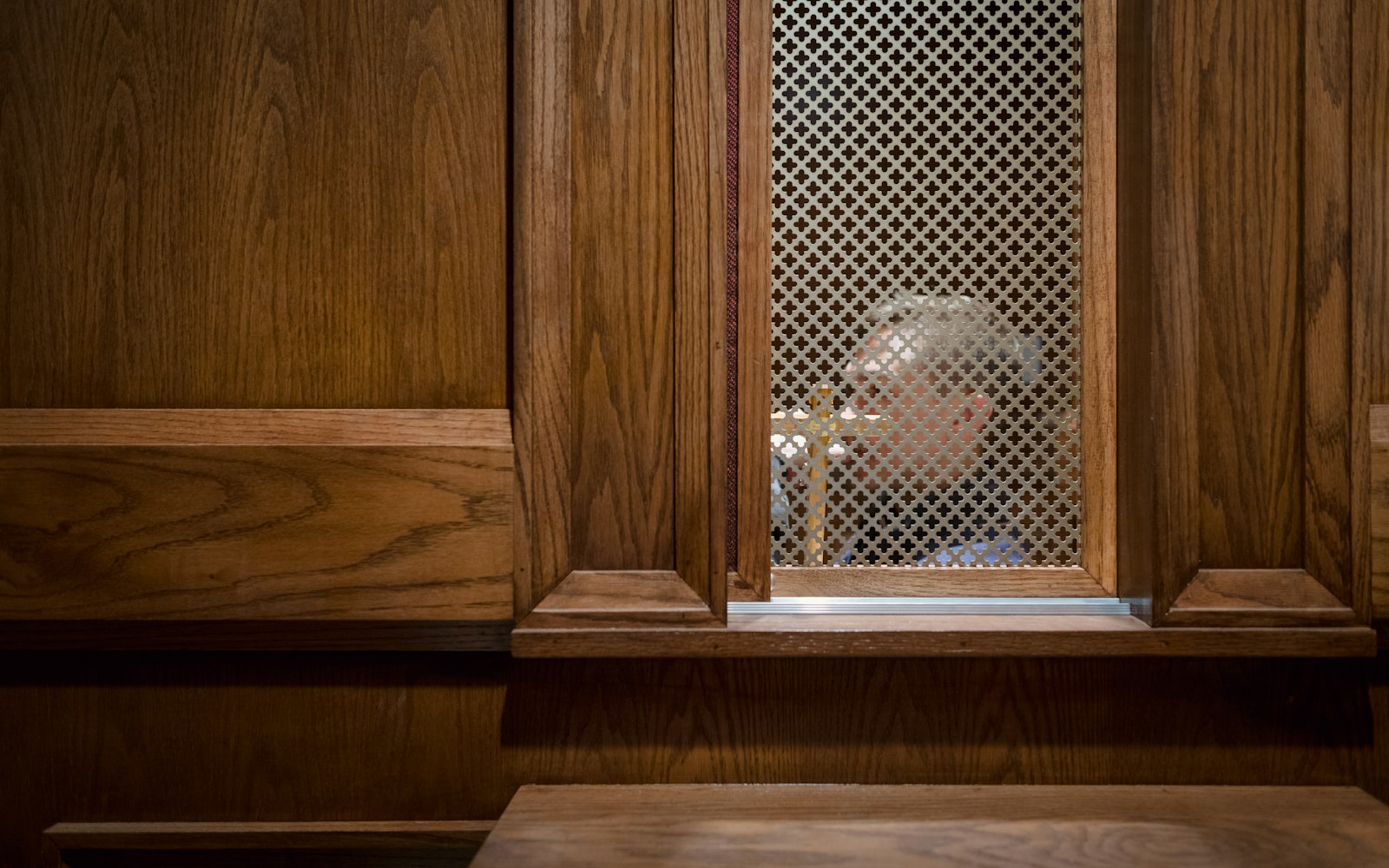
In Montreal's Hochelaga-Maisonneuve neighbourhood, the former Église Saint-Mathias-Apôtre now operates as Le Chic Resto Pop, a nonprofit restaurant serving 600 meals a day at solidarity prices (Associated Press, July 2025). The original wooden confessional booths still stand inside — decorative now, framing diners rather than penitents.
It is a useful image for the number that follows.
We mapped confession schedules across 1,789 Catholic parishes in Quebec. Sixty-three of them — 3.5% — list confession times. In the rest of Canada, the figure is 30%. One Quebec church in twenty-eight offers scheduled confession. Outside Quebec, it is roughly one in three.
That is not a gap. That is a cliff.
Key Findings
- 3.5% of Quebec parishes list confession times — versus 30% in the rest of Canada, nearly a 9x gap
- Adoration survived: 12% of Quebec parishes offer it, compared to 14% elsewhere — near parity
- The gap is binary: where confession is offered, both sides average 3.0 slots per church — the difference is entirely in whether a parish offers it at all
- Quebec Mass attendance collapsed from ~88% in the 1950s to under 5% today — one of the steepest drops in the Western world
- 762 Quebec churches have been closed, demolished, or converted since 2003 — roughly one every eleven days
Based on 5,590 Canadian parish schedules. Methodology ↓
The Confession Cliff
Quebec
3.5%
of churches list confession
63 out of 1,789
Rest of Canada
30%
of churches list confession
1,145 out of 3,801
In the rest of Canada — Ontario, Alberta, the Prairies, the Maritimes, British Columbia — roughly one in three churches publishes a confession schedule. That is not generous by any standard. But it is a functioning system. If you want to go to confession in Calgary or Ottawa or Halifax, you can find a time slot.
In Quebec, if you picked a parish at random and drove there looking for confession, you would have a 96.5% chance of finding nothing scheduled.
The number that reframes the story, though, is not 3.5%. It is 3.0. Quebec parishes that do offer confession average 3.0 slots per church — identical to the rest of Canada. The gap is not in how much confession is offered. It is in whether confession is offered at all. Among the 63, the commitment is the same as everywhere else. Among the other 1,726, the answer is zero.
Where Confession Still Exists
The 63 parishes are not spread evenly. They cluster in Montreal, and the standouts are communities that followed a different trajectory through the Quiet Revolution.
St. Michael the Archangel is a Ukrainian Catholic parish in central Montreal, founded in 1911 by immigrants who had spent years relying on visiting priests. It belongs to the Eparchy of Toronto — Byzantine rite, not Latin. It opens its confessional at 6:30 AM every day and again at 6:30 PM. Seventeen slots a week, more than some entire Quebec dioceses combined.
The Cathédrale de l'Assomption in Trois-Rivières, a Westminster-style cathedral dating to 1858 with 125 stained glass windows by Guido Nincheri, hears confessions twice daily, six days a week. Saint Patrick's Basilica — the old English-speaking parish on René-Lévesque Boulevard, a National Historic Site completed in 1847 for Montreal's Irish community — offers nine slots.
These are not typical Quebec parishes. They are Eastern Rite communities, Anglophone enclaves, religious orders — institutions that moved through the Quiet Revolution on a separate track. The typical francophone Quebec parish offers no scheduled confession at all.
The Adoration Anomaly
This is where the data gets strange.
Quebec vs. Rest of Canada
Percentage of parishes offering each service
Confession
Rest of Canada30%
1,145 of 3,801
Adoration
Rest of Canada14%
542 parishes
Mass
Rest of Canada55%
2,074 parishes
The anomaly: Confession availability drops nearly 9x in Quebec — but adoration (which requires no priest) stays near parity.
Quebec churches offer adoration at nearly the same rate as the rest of Canada: 12% versus 14%. That two-point gap is nothing compared to the 27-point chasm in confession.
Why would adoration survive when confession did not?
The most likely explanation is structural. Adoration requires far less priestly involvement — a priest or deacon must perform the brief exposition, but a single parishioner can sustain the holy hour itself. Confession requires a priest sitting in a confessional, available, waiting. In a province where the Archdiocese of Quebec has consolidated from 200 parishes to 38, where Cardinal Gérald Lacroix has said publicly that "the parish system that had a strong impact on French Canadian society is not sustainable and needs to evolve" (America Magazine, January 2021), there are simply not enough priests to staff confessionals.
The Archdiocese of Quebec had 1,565 priests in 1966. By 2014, it had 634 — a roughly 60% decline. The ratio of Catholics per priest more than tripled.
Quebec's Catholic life did not disappear uniformly. The parts that depend on ordained ministry disappeared. The parts that don't, held on.
The Steepest Collapse in the Western World
In the 1950s, Quebec had the highest Mass attendance rate in the Western world: roughly 88%. Today, by most estimates, between 2% and 5% attend weekly. Philip Jenkins, writing in The Christian Century, described how Quebec went "from one of the most religious societies to one of the least." Among Western democracies, only the Netherlands experienced a comparable collapse.
88%
Mass attendance, 1950s
~3%
Mass attendance, today
762
churches closed since 2003
The Quiet Revolution of the 1960s secularized Quebec's schools, hospitals, and social services — all of which had been run by the Church. The Ministry of Education was created in 1964 for the first time since 1875. CEGEPs replaced Catholic colleges. Healthcare moved to the state. The change was political, but the effect was existential.
Catholic self-identification in Quebec dropped from 75% in the 2011 census to 54% in 2021. The people who still check "Catholic" are, increasingly, expressing a cultural memory rather than a living practice.
In 2019, Quebec passed Bill 21, banning religious symbols for public servants in positions of authority — teachers, police officers, judges. A crucifix had hung above the Speaker's chair since 1936 — though the original had been replaced in 1982 — and it was removed the same year. The symbolism was not subtle.
762 churches have closed since 2003. Many became condominiums, restaurants, climbing gyms, microbreweries. The confessional booths at Le Chic Resto Pop — our opening scene — are one version of this story. Théâtre Paradoxe, a former church now hosting live music in the old nave — and a social enterprise training at-risk youth — is another. The infrastructure of sacramental life didn't just decline. It was physically repurposed.
One data point deserves mention because it is so strange. In Quebec, the top service category in our database is not Mass, not confession, not adoration. It is "Other" — with 3,738 entries. In the rest of Canada, the top category is Mass, at 15,237.
| Metric | Quebec | Rest of Canada |
|---|
| Total churches | 1,789 | 3,801 |
| Churches with confession | 63 (3.5%) | 1,145 (30%) |
| Churches with adoration | 219 (12%) | 542 (14%) |
| Churches with Mass times listed* | 559 (31%) | 2,074 (55%) |
| Sunday share of Masses | 41% | 30% |
| Top service category | Other (3,738) | Mass (15,237) |
*Every active Catholic parish is required to offer Sunday Mass under canon law. The "listed" figure reflects how many publish Mass schedules online — not how many actually celebrate Mass. The gap measures data completeness, not reality. Confession and adoration, by contrast, are genuinely discretionary — their absence from parish websites more likely reflects actual absence of the service.
"Other" captures everything that isn't a standard sacramental service: prayer groups, community meals, cultural events, building rentals. When your top service category is "Other," your churches are still being used — but not primarily as churches. Community centres with steeples.
The Sunday Mass data tells a related story. 41% of Quebec's listed Masses fall on Sunday, compared to 30% elsewhere. Quebec's remaining Mass infrastructure is concentrated on the one day a parish cannot skip. Weekday Mass — the daily rhythm that sustains parish life — has largely disappeared. What remains is the Sunday obligation and not much else.
A Note on What We're Measuring
Our data captures scheduled services listed on parish websites and diocesan directories. A church that lists no confession times may still hear confessions informally — a priest sitting before Mass, a phone call to the rectory. But 3.5% versus 30% is too large to be a data quality problem. Even tripling Quebec's numbers leaves you at 10.5%. The gap is real, and either explanation — confession is unavailable or confession is simply not prioritized enough to list — tells the same story about where the sacrament stands.
The Arithmetic
The standard narrative of Quebec's Catholic decline is theological and cultural — that the Quiet Revolution freed a province from clerical domination, and that modern Quebecers simply lost the sense of sin. Our data suggests a simpler, more structural story.
Confession requires a priest, a confessional, and scheduled hours. Adoration requires brief priestly involvement for exposition, a monstrance, and one person willing to sit in silence. In the province where institutional support withdrew most completely, the sacrament that depends most on institutional support disappeared — and the one that doesn't, survived.
The confessional booths at Le Chic Resto Pop still have their original wooden doors. No one has knelt in them for years. Across the province, 1,726 parishes publish no confession schedule at all. Sixty-three do, and those sixty-three offer it at the same intensity as any parish in Alberta or Ontario.
That is not a theological argument. It is arithmetic.
Find Confession Times in Canada
Catholic Index tracks confession schedules at over 5,500 parishes across Canada — including all 63 Quebec parishes that list them. Search by city, postal code, or parish name.
This is part of a series on Canadian Catholic data. Read the national picture: Canada's Confession Crisis, Province by Province
Methodology & Sources
Data sourced from Catholic Index's database of Canadian parish schedules, current as of March 2026. Covers 5,590 churches: 1,789 in Quebec, 3,801 in the rest of Canada. Schedules were scraped from parish websites and diocesan directories using identical methodology across all provinces. "Churches with confession" means parishes with at least one confession time slot published online. Churches without published schedules may still offer services not captured here — the 41% of Quebec churches with zero scraped services may have schedules not available digitally.
The "3.0 slots per church" figure represents the average number of distinct weekly confession time slots among parishes that list at least one. The "Other" service category captures non-standard services: prayer groups, community events, building-use entries, and services that do not map to Mass, Confession, Adoration, Devotions, Sacraments, Education, Community, or Private categories.
- Jenkins, Philip. "How Quebec went from one of the most religious societies to one of the least." The Christian Century, May 5, 2021.
- "Cardinal Lacroix prepares the dwindling number of Catholics in Quebec for the end of parish life as they know it." America Magazine, January 26, 2021.
- Archdiocese of Quebec priest statistics: Catholic-Hierarchy.org (1966 and 2014 figures).
- Church closures: Conseil du patrimoine religieux du Québec (762 since 2003, per Canadian Press, February 2026).
- "Churches in once Catholic-dominated Quebec get new secular roles." Associated Press via Washington Post, July 29, 2025.
- Catholic self-identification decline: Statistics Canada Census 2011 vs. 2021.
- Bill 21: An Act Respecting the Laicity of the State, Quebec National Assembly, 2019.
- O'Toole, James M. For I Have Sinned: The Rise and Fall of Catholic Confession in America. Harvard University Press, 2025.
- St. Michael Ukrainian Catholic Church history: ukemonde.com/stmichael.
- Cathédrale de l'Assomption: Répertoire du patrimoine culturel du Québec; Nincheri windows per The Canadian Encyclopedia.
- Saint Patrick's Basilica: Parks Canada National Historic Site designation.
- "Loss of government funding, secularism putting many Quebec churches 'on the brink.'" Canadian Press via CP24, February 11, 2026.