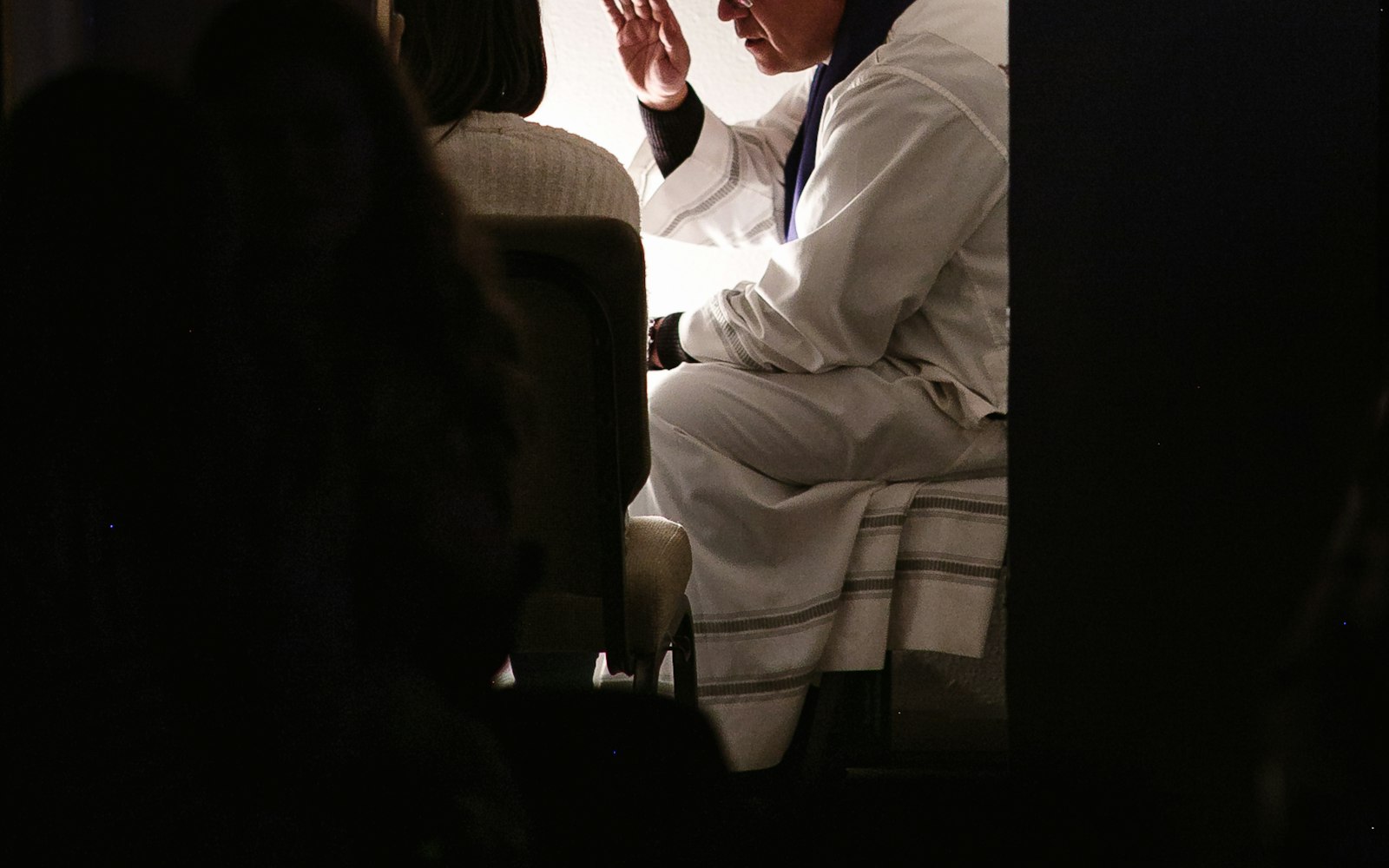
A Tent on Steele Street
At 406 Steele Street in Whitehorse, Yukon, Sacred Heart Cathedral serves a diocese of 8,749 Catholics spread across a territory larger than Spain. The original church on the site was built in 1900 by Father Camille Lefebvre and Brother Augustin Dumas, who pitched a tent and started building. The cathedral replaced it in the early 1960s. Today it publishes confession times that would embarrass most parishes in Toronto: Monday through Friday 11:30 to noon, Saturday 4:00 to 4:45, and Thursdays from 9:00 AM to 8:00 PM — with a break for the 12:10 Mass.
That Thursday marathon — nearly ten hours of availability — is the opposite of typical. Across Canada, we mapped 5,590 parishes and found that 78.4% of them publish no scheduled confession time at all. The sacrament of reconciliation, in the country that was once called "New France," is structurally unavailable at four out of five Catholic churches — or at minimum, unavailable to anyone looking for it online.
Key Findings
- 78.4% of Canadian parishes (4,382 of 5,590) publish no scheduled confession time
- 49.1% of churches with confession offer just one slot per week — miss it, wait seven days
- Quebec — historically Canada's most Catholic province — has only 63 churches with scheduled confession
- The Yukon averages ~15 confession slots per church — the highest ratio in the country
Based on 3,548 confession slots across 5,590 Canadian parishes. Methodology ↓
The 78% Problem
In the United States, we found that roughly 67% of parishes publish confession schedules. In Canada, the number is 21.6%. Only 1,208 churches across the entire country list a scheduled time for the sacrament of reconciliation. The remaining 4,382 either offer confession by appointment or don't mention it at all. If you go looking for a time — the way you'd look for a Mass time, or a baptism class, or an office hour — the answer, almost 80% of the time, is silence.
5,590
Canadian parishes mapped
78.4%
with no scheduled confession
3,548
total confession slots
49.1%
offer just 1 slot/week
Canadian parishes simply do not schedule confession the way American parishes do. And among the minority that do, nearly half offer just one slot per week. One chance. One window. Miss it, and you wait seven days.
Saturday dominates the schedule, as it does south of the border: 783 slots (22%) fall on Saturday. But the second-largest category is telling — 755 slots have no day specified at all, listed as available "before Mass" or "by appointment" without naming a specific day of the week. The ambiguity itself is the message.
The Quebec Paradox
Quebec is the outlier that distorts the national average. Of 1,789 parishes, just 63 schedule confession — one in twenty-eight. Weekly Mass attendance has collapsed from 88% in 1957 to roughly 2-5% today. Meanwhile, 762 churches have been closed, demolished, or converted since 2003.
The story of how the most Catholic society in North America became one of the least is its own article. The short version: the Quiet Revolution secularized the province faster than almost anywhere in Christian history, and the confession infrastructure vanished with everything else — while adoration, which requires far less priestly involvement, quietly survived.
What matters for the national picture is the contrast. Quebec has 3.5% of its parishes offering confession. The rest of Canada: 30%. Remove Quebec from the dataset, and Canada's confession rate nearly doubles.
Province by Province
Outside Quebec, the picture varies enormously. Ontario leads the country in raw numbers, and it is not close.
Confession by Province
Churches with scheduled confession and total weekly slots
| Province / Territory | Churches | Slots | Avg slots/church |
|---|
| Ontario | 483 | 1,436 | 3.0 |
| Alberta | 172 | 491 | 2.9 |
| Saskatchewan | 161 | 232 | 1.4 |
| British Columbia | 125 | 597 | 4.8 |
| Manitoba | 68 | 195 | 2.9 |
| Quebec | 63 | 192 | 3.0 |
| Yukon | 8 | 123 | ~15 |
| Other provinces/territories | 128 | 282 | 2.2 |
Ontario's 483 churches with confession and 1,436 slots represent the densest confession infrastructure in the country. Among cities, Ottawa leads with 137 slots across 28 churches — more than Toronto, a city nearly three times its size. At Saint Patrick Basilica on Nepean Street — Ottawa's oldest English-speaking parish, a Heritage Building since 1987, with ceiling murals and stained glass by the Italian-Canadian artist Guido Nincheri — confession is available before every weekday Mass, at 7:00, 11:45, and 4:00. That is 17 slots per week. Nearly half of Canada's parishes with confession offer exactly one.
Saskatchewan: The Consolidation Effect
Saskatchewan is the surprise in the data. With a population of just over one million, the province has 161 churches with scheduled confession — more than Quebec, more than British Columbia, and nearly as many as Alberta despite having a fraction of its population. For a rural, sparsely populated prairie province, this is remarkable.
The explanation may lie in how each province lost its churches. In 1998, the Diocese of Gravelbourg was dissolved, its parishes absorbed into the Archdiocese of Regina and Diocese of Saskatoon. Consider Govan, Saskatchewan — population 200. As CBC reported in 2019, the town once had seven churches. Now it has two: one Lutheran, one Catholic, and the Catholic one is part-time. The National Trust for Canada has estimated that 9,000 of 27,000 religious buildings across the country will be lost in the next decade. Govan is the trend made local: a town that once had a church for every 28 residents now shares a part-time priest.
But here is what happened to the sacramental life of Govan and towns like it: it concentrated. The churches closed, but the remaining parishes absorbed the people. The confession schedule survived because the parish survived.
Quebec's parishes emptied before they closed. Saskatchewan's parishes closed before they emptied. And it turns out that a closed parish whose people drive to the next town preserves more sacramental life than an open parish with no one in it. The prairie Church is shrinking, but it has not stopped staffing the confessional.
The Yukon Outlier
Then there is the Yukon. Eight churches. A hundred and twenty-three confession slots. An average of roughly 15 slots per church — five times the national average.
The ratio is heavily influenced by Sacred Heart Cathedral and its marathon Thursday hours. But it still points to something real. The Diocese of Whitehorse covers roughly 724,000 square kilometres — the Yukon plus northern British Columbia — with a Catholic population under 9,000. There are no surplus priests, no wealthy endowments, no large immigrant communities propping up the pews. What there is, apparently, is a decision to keep confession available.
The Oblate missionaries who pitched that tent on Steele Street in 1900 were building for a territory that didn't yet have provincial status. The cathedral that replaced the tent has outlasted the gold rush, two world wars, and the near-total secularization of the country around it. And on Thursdays, the light is still on.
Drive-Through Mercy
The pandemic tested every assumption about how sacraments could be delivered. In April 2020, at St. Patrick's Parish on Main Street in Vancouver, Rev. James Hughes sat in a burgundy chair in the church parking lot, orange traffic cones marking two metres of distance, and heard confessions. Nearby, Rev. Felix Min sat behind a sheet of frosted glass balanced on a folding table. Parishioners chose to stand rather than sit, to avoid the need to sanitize chairs between penitents. Maclean's, CBC, and CTV all covered the scene.
It was improvised, undignified by traditional standards, and — by every account — packed. The demand was not created by the pandemic. The pandemic just made the demand visible by removing every other option. When the only way to confess was to stand in a parking lot next to traffic cones, people stood in a parking lot next to traffic cones.
Holy Rosary Cathedral in Vancouver — Gabriola Island sandstone, opened in 1900, now surrounded by the offices of Amazon and Apple — publishes confession Monday through Saturday, 11:00 to 11:45 and 4:00 to 4:45. Twelve slots per week, in a city where the drive-through confessionals of 2020 proved that the hunger had never gone away.
A Sacrament the Church Stopped Counting
The description of confession as a "ghost sacrament" — a phrase used by a priest quoted in historian James O'Toole's work — in the American context applies with even more force in Canada. In Canada, the ghost is not a metaphor. It is a scheduling reality. In the U.S., monthly confession fell from 38% in 1965 to 17% by 1975, and has continued to decline since — settling in the single digits by most estimates. Canada has no comparable longitudinal data, but the structural indicators are worse: fewer parishes per capita, a steeper secularization curve in the largest Catholic province, and a confession-publishing rate less than one-third of the American one.
The Canadian Church does not count confessions. Neither does the American Church. But the Canadian Church has gone a step further: in the majority of its parishes, it does not even schedule them.
The Archdiocese of Toronto has pushed back against this trend. Its annual "Day of Confessions" initiative — held December 14-20 in 2025 — offered confession guides in eight languages and published a full schedule of availability across the archdiocese. It is a deliberate effort to lower the barriers: no appointment, no phone call, multiple languages, guaranteed times.
Two Countries, One Pattern
The Canadian and American data tell parallel stories with different magnitudes. In the U.S., the sacrament has been compressed into a Saturday afternoon window. In Canada, it has been compressed further — into near-invisibility.
United States
67%
of parishes publish confession times
Canada
21.6%
of parishes publish confession times
But the churches that do schedule confession in Canada look remarkably similar to their American counterparts. Canadian churches with confession average 2.9 slots per church; American churches average 2.8. The difference is not what the available churches do. The difference is how many churches make confession available at all.
This suggests the problem is not pastoral laziness in individual parishes. It is systemic — a Church-wide deprioritization of the sacrament that has proceeded further in Canada than in the United States, driven by the same forces (priest shortages, secularization, liturgical reform) but amplified by Canada's particular history. The Quiet Revolution. The collapse of the Catholic school monopoly. The speed of Quebec's transformation. The consolidation of rural dioceses across the prairies. Each of these has its own story, but they converge on the same outcome: a confessional with no one in it, and eventually, no hours posted on the door.
The Tent and the Tower
The cathedral on Steele Street is not a large building. It does not have the Gabriola sandstone of Holy Rosary or the Nincheri murals of Saint Patrick Basilica. It serves a Catholic population smaller than a mid-sized Toronto parish. But on a Thursday in March, when most of Canada's 5,590 Catholic parishes have locked their confessional doors — or never posted hours to begin with — Sacred Heart Cathedral in Whitehorse has a priest available from 9:00 in the morning until 8:00 at night.
The Oblates who pitched a tent on that site 126 years ago understood something that the data now confirms. Mercy does not require a large congregation. It does not require a wealthy diocese or a surplus of clergy. It requires a decision — a decision to post the hours, open the door, and wait.
Four out of five Canadian parishes have not made that decision. A hospital that believes in surgery but doesn't staff the operating room has made a decision, even if it didn't mean to. The 4,382 churches with no scheduled confession are not necessarily parishes without mercy. Many will hear your confession if you call, if you ask, if you catch the priest after Mass. But a sacrament that requires you to ask is a sacrament that has shifted the burden from the institution to the individual. And for the Catholic carrying a weight they cannot name to a secretary over the phone, that shift is the difference between going and not going.
Somewhere in Govan, Saskatchewan, population 200, someone will drive twenty minutes on a gravel road to get to one of the two remaining churches, because that's what the schedule says. That parishioner is not part of a revival. They are not a trend piece. They are just someone who wants to go to confession and found a place that still offers it.
The tent on Steele Street became a cathedral. The cathedral kept posting hours. Somewhere in that persistence is the answer to the question the rest of the Canadian Church has not yet asked.
Find Confession Times Near You
Catholic Index tracks confession schedules at over 5,500 parishes across Canada and 16,600 in the United States — updated regularly from parish websites and bulletins.
Search Confession Times →
This is part of a series on Canadian Catholic data. Read the Quebec deep-dive: Quebec Stopped Going to Confession. We Mapped What's Left.
Methodology & Sources
Data sourced from Catholic Index's database of Canadian parish schedules, covering 5,590 parishes as of March 2026. Confession schedules were extracted from parish websites, diocesan directories, and published bulletins. The 78.4% figure (4,382 parishes with no scheduled confession) represents parishes for which we found no publicly listed confession time — some may offer confession informally, by appointment, or before Mass without advertising it online.
"Confession slot" = one scheduled time block on one day. A parish offering Saturday 3-4pm and Wednesday 6-7pm has two slots. Slots with no specified day (755 of 3,548) were counted in totals but excluded from day-of-week analysis where applicable. Province-level counts reflect the number of parishes with at least one published regular confession time. The Yukon's high per-church average is heavily influenced by Sacred Heart Cathedral, Whitehorse.
Know of a Canadian parish with confession times we're missing? Contact us.
- Sacred Heart Cathedral, Whitehorse: sacredheartcathedral.ca; BaladoDiscovery; Yukon News.
- Saint Patrick Basilica, Ottawa: basilica.ca; Wikipedia.
- Holy Rosary Cathedral, Vancouver: holyrosarycathedral.org; Wikipedia; Daily Hive.
- Drive-through confessions, Vancouver: Maclean's, April 2020; CBC; CTV.
- Cardinal Lacroix on parish consolidation: America Magazine, January 2021.
- Govan, Saskatchewan: CBC, March 2019. National Trust for Canada religious buildings estimate.
- Quebec church closures (762 of 2,746): Conseil du patrimoine religieux du Québec. Solange Lefebvre, Université de Montréal, quoted.
- Toronto "Day of Confessions": archtoronto.org, December 2025.
- O'Toole, James. For I Have Sinned: The Rise and Fall of Catholic Confession in America (Harvard University Press, 2025).
- Jenkins, Philip. The Christian Century: Quebec secularization.
- Census data: Statistics Canada, 2011 and 2021 National Household Survey / Census.
- Quebec Mass attendance (1957): Bibby/Gallup survey data; contemporary estimates: 2-5%.
- Diocese of Gravelbourg dissolution: Catholic Register, 1998.