
Today · Wednesday, June 17
Next Mass
Today's Readings7:00PM
Our Mother of Perpetual Help Novena & Mass
Today
Today
Why does another Mass times site exist? Read my story →
by Father Randy Sampinto, AM
Much of human life is marked by a quiet longing. We hope to satisfy the hunger within us in places, experiences, and relationships. Yet even in our happiest moments, the heart still yearns for more. That restlessness is not a flaw but a sign that we were made for communion with God. As Saint Augustine wrote, "You have made us for Yourself, O Lord, and our hearts are restless until they rest in You" (Confessions, I.1).
The Catholic faith proclaims something astonishing: the God we seek is already seeking us. He comes to meet us not from a distance, but personally, sacramentally, and completely. This is the mystery of the Eucharist: God giving Himself to us as the fulfillment of the deepest longing of the human heart.
The Eucharist is not merely a ritual or symbol. It is Jesus Himself, truly and substantially present, remaining with His people as the Bread of Life who satisfies the deepest hunger of the human heart. I came to understand this deeply a few days after my ordination to the priesthood.
One morning, after celebrating Mass in a parish church, a woman who had learned that I was newly ordained invited me to breakfast. During our conversation, she asked, "Father, now that you are a priest, what else are you dreaming of?"
Almost instinctively, I answered, "I would love to visit the Holy Land someday."
"Why?" she asked.
"I want to walk where Jesus walked," I replied, "to feel close to Him in the places where He once lived." She smiled gently and said something I have never forgotten: "Father, I have been to the Holy Land several times, but I think you are more blessed, and we are blessed too through your priesthood."
Surprised, I asked, "What do you mean?" She answered, "Because through your priesthood, Jesus becomes truly and substantially present whenever and wherever the Eucharist is celebrated. Some people may not be able to make a pilgrimage to the Holy Land, but everyone can encounter Jesus in His Real Presence anywhere in the world because, at every Mass, He comes to us here and now."
Her words stayed with me. And that morning, I realized more deeply that the greatest pilgrimage is not only to stand in the places where Jesus once lived, but to encounter Him truly alive and present on the altar. The same Jesus who once walked the roads of Galilee now comes to us truly, sacramentally and personally in every Mass.
I believe that is what makes the Eucharist both so compelling and so challenging. The Church is not simply claiming that the Eucharist reminds us of Jesus. She proclaims that Jesus truly gives Himself to us in the Eucharist.
I have been a priest for seventeen years, and I still cannot claim to fully understand this "so great a sacrament." Every Mass I celebrate and every moment I spend before the Blessed Sacrament remain both deeply personal and profoundly mysterious. Yet faith continually seeks deeper understanding, leading us to ask, 'What is the Eucharist?'
Eucharist: A Sacrament
The Catechism defines a sacrament as "an efficacious sign instituted by Christ to give grace" (CCC 1131). Through visible and material realities, such as water, oil, bread, wine, words, and touch, God communicates His divine life. Because we are both body and soul, we encounter reality through what we can see, hear, touch, taste, and experience. In the sacraments, God meets us through these visible signs.
The Eucharist is the fullest expression of this sacramental mystery. The Church calls it "the source and summit of the Christian life" (CCC 1324) because in the Eucharist Christ does not simply give grace, strength, or encouragement. He gives Himself. Under the signs of bread and wine, Jesus becomes truly present and feeds His people with His own life. Christ becomes for us the Bread of Life.
Eucharist: A Real Presence
When Catholics speak of the "Real Presence," we mean something very specific. The Eucharist is not merely a symbol, a reminder, or an emotional experience of Jesus. At Mass, when the priest acts in persona Christi (CCC 1548) and repeats Christ's words from the Last Supper, "This is my body... this is my blood," the bread and wine truly become the Body and Blood of Jesus Christ, not symbolically, but truly and substantially: Body, Blood, Soul, and Divinity.
The appearances remain the same. The bread still looks and tastes like bread; the wine still appears as wine.
Yet what they are has changed. The Church explains this mystery as transubstantiation: the substance of bread and wine becomes Christ Himself while the outward appearances remain. (cf. CCC 1376)
The Church also teaches the doctrine of concomitance (CCC 1390). Because the risen Christ cannot be divided, He is wholly present under either form of the Eucharist. Whether one receives the consecrated Host or the Precious Blood, one receives the whole Christ: Body, Blood, Soul, and Divinity. This is why even the smallest fragment of the Host is treated with reverence.
The Church insists on this teaching because the stakes are profound. If the Eucharist were only symbolic, it might inspire or comfort us, but it could not truly give divine life. This conviction begins with the words of Jesus Himself. At the Last Supper, He did not say, "This represents my body." He said, "This is my body."
Because Catholics believe the Eucharist is truly Christ, Holy Communion is approached with reverence and proper disposition. According to Canon Law, those ordinarily admitted to Holy Communion are baptized Catholics who have reached the age of reason, are properly disposed, and share the faith of the Church regarding the Eucharist (CIC can. 912; can. 913 §1).
In rare and grave circumstances, especially in danger of death, other Christians may be permitted to receive the Eucharist if they freely request it, profess Catholic faith in the sacrament, are properly disposed, and cannot access a minister of their own community (cf. CIC can. 844 §4).
This same reverence extends beyond Mass. Christ's Real Presence remains in the consecrated Eucharist, which is reserved in the tabernacle so that we may continue to encounter and adore Him. Eucharistic adoration naturally flows from this belief, inviting us to remain with Jesus in prayer and worship long after Mass has ended. (cf. CCC 1373)
Eucharist: Sacrifice and Communion
The Eucharist is the heart of Christian worship because it is both sacrifice and communion. In every Mass, Jesus Christ does not die again; rather, His one eternal sacrifice on the Cross is made sacramentally present. (Cf CCC 1362–1367) We are drawn into His perfect offering of love to the Father, not as distant spectators, but as participants in the mystery of salvation itself.
But the Eucharist is not only the sacrifice of Christ; it is also the sacrament of unity. Christ gives Himself to His people so that they may become one in Him. In Holy Communion, we are united not only with Christ, but also with one another as His Body, the Church. (1 Cor10:16– 17) The Eucharist gathers what is scattered, heals what is divided, and forms a communion deeper than human friendship or shared ideals, a communion rooted in the very life of God.
In a fractured and lonely world, the Eucharist reveals that salvation is never merely private. God draws His people into communion with Himself and with one another, nourishing them with His own presence and making them one through love.
Concluding Reflection
In the Gospel proclaimed for the Solemnity of Corpus Christi, Jesus says, "Amen, amen, I say to you, unless you eat the flesh of the Son of Man and drink his blood, you do not have life within you" (John 6:53). These words are difficult and startling, and many who heard them struggled to accept them.
In the verses that follow, though not included in the Gospel reading, many disciples turn away in confusion and disbelief. Yet Jesus does not soften His words. Instead, He asks the Twelve, "Do you also want to leave?" Peter replies with the honesty of faith: "Lord, to whom shall we go? You have the words of eternal life." That moment reveals the very heart of the Eucharist. The deepest question is not simply, 'What is the Eucharist?' but even more profoundly, 'Who is Truly Present in the Eucharist?'
From the beginning, the Church has proclaimed an answer that is both simple and astonishing: the Eucharist is Jesus Christ Himself—truly present, living, and giving Himself to His people. The Eucharist is not merely something we receive; it is Someone with whom we are called into communion and relationship. The Eucharist is not merely a symbol or a memory of Christ. It is Christ alive among us, feeding the hungry heart, remaining with the lonely, strengthening the weak, and drawing His people into communion with God and with one another.
In receiving Him, we are being transformed, becoming more capable of love, forgiveness, sacrifice, and peace. The Eucharist not only draws us into communion with Christ; it sends us forth to carry His love into the world. The Lord we receive and adore in the Eucharist is the same Lord who waits for us in the poor, the suffering, and the forgotten.
This is why the Eucharist continues to captivate hearts across every age. In a world marked by distance and restlessness, the Eucharist proclaims a profound promise: God is not absent. He remains with His people. The same Jesus who walked the roads of Galilee still comes to us intimately and personally, fulfilling His promise: "I am with you always."
May our celebration of the Solemnity of the Most Holy Body and Blood of Christ inspire, renew, and deepen both our understanding and our relationship with Jesus Christ, who is truly and substantially present in the Eucharist, Body and Blood, Soul and Divinity.
Olga Alvarado • Marybeth Beck • David Bell Jenni Bell • Susan Bell • Patty Brancato Stella Costello • Ed Dunn Jr. • Ken Francis Isabel Furtado • Eddy Handford • Bruce Kaschmitter Milagros Kushner • Tom Lacy Jim Maitland • Charlotte McPherson Danette Michelini • Dru Moschel Robert Rodriguez • Yolanda Siegenfeld Jenna Spector • Grace Whittaker
Parishioners who are homebound or residing in care centers
Rene Canent † Virginia Cartier
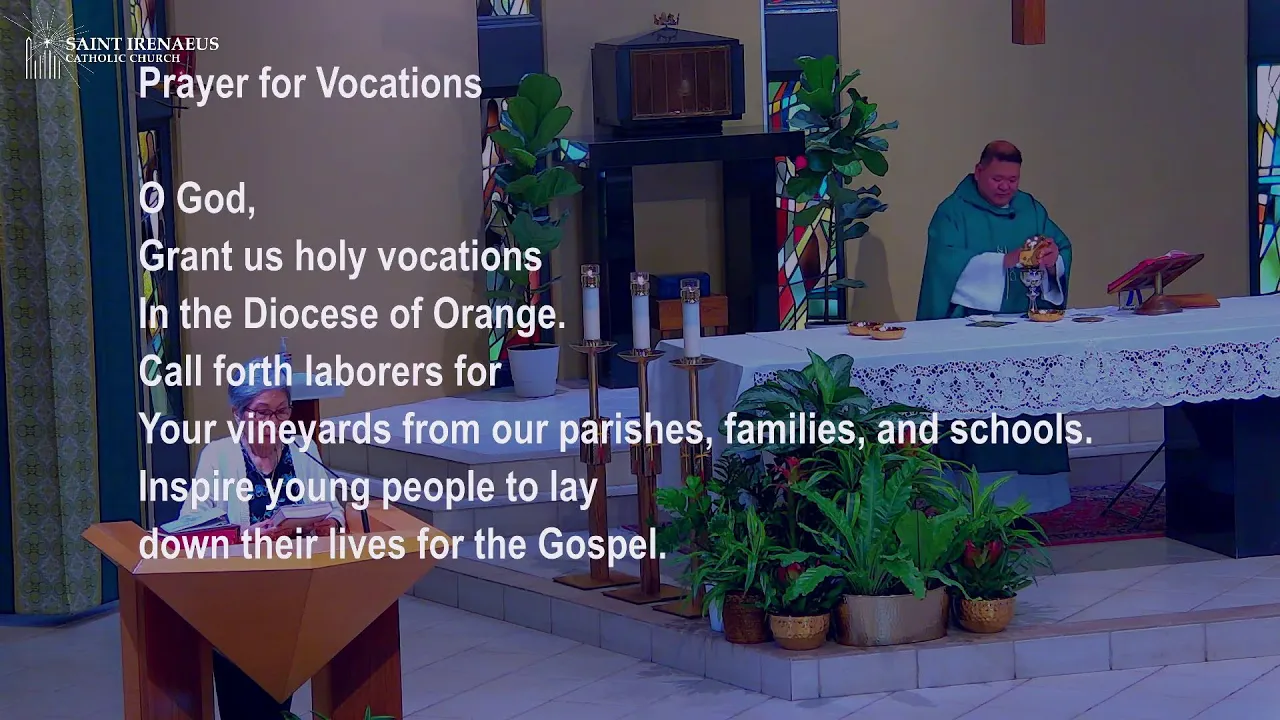
Livestreams Sundays at 3:30 PM
 46:00
46:00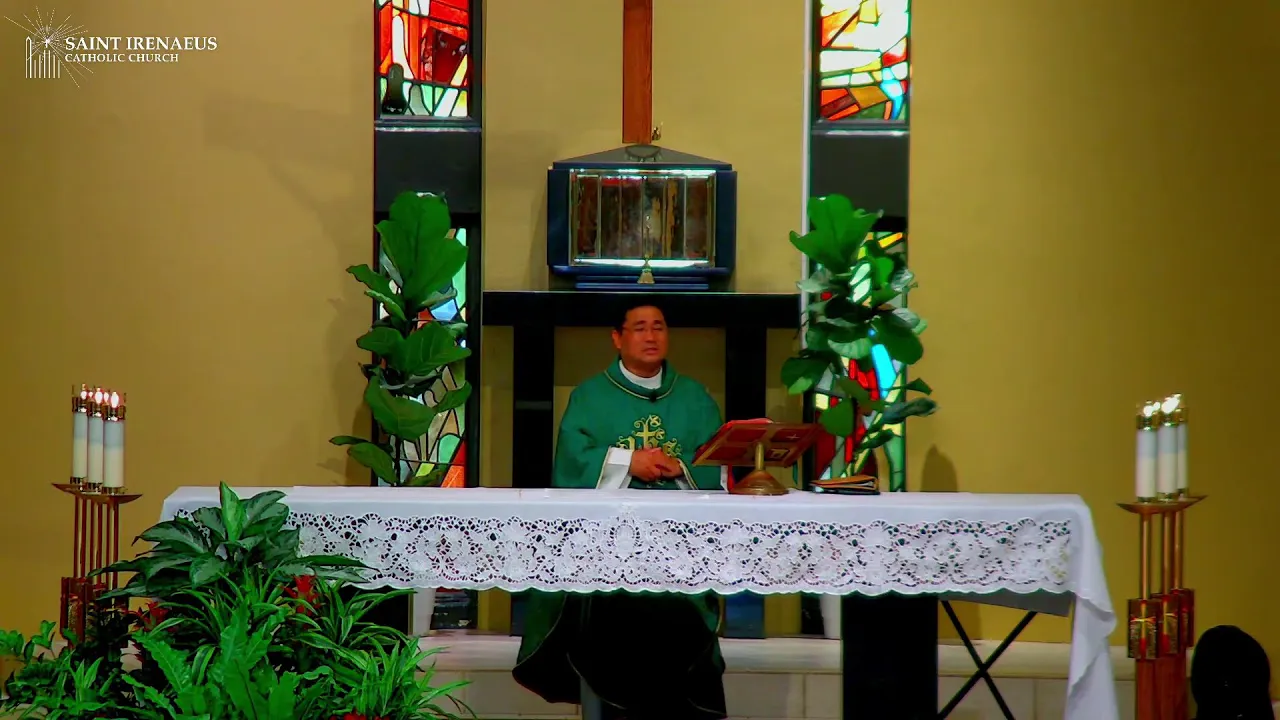 46:08
46:08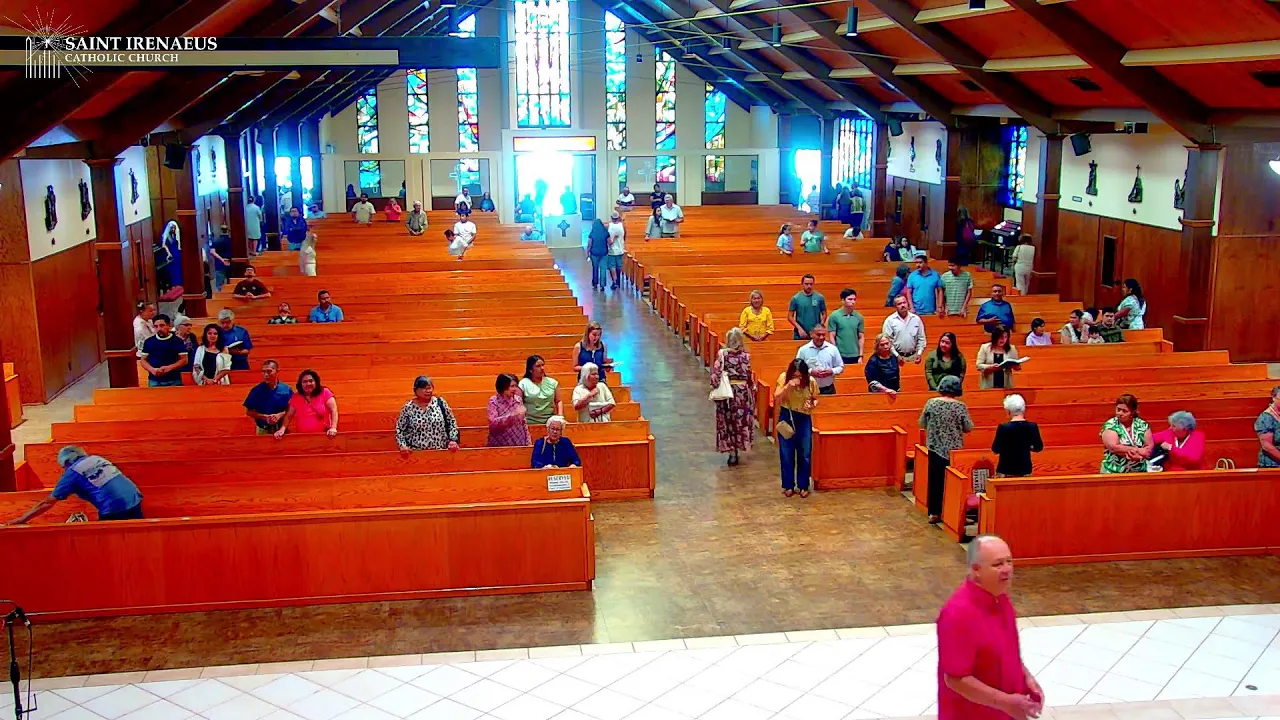 76:45
76:45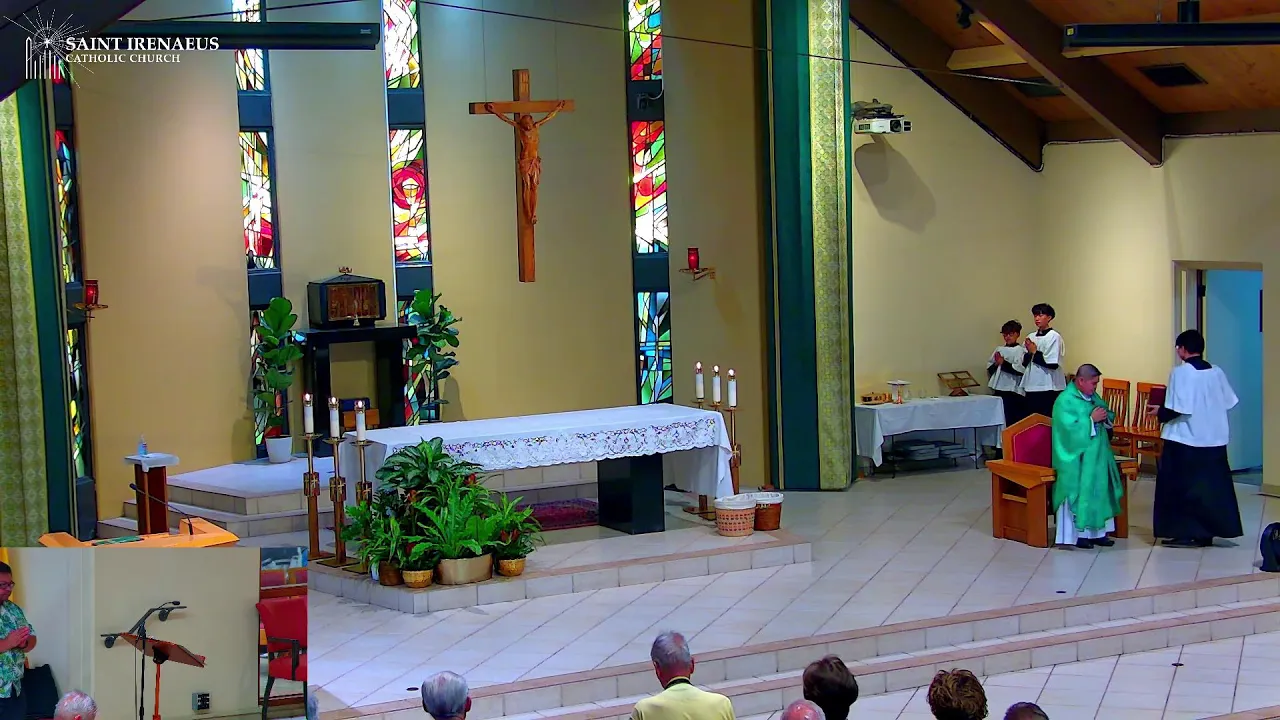 77:27
77:27The community is very welcoming and the people are noted as being very nice.
Catholic Index is not affiliated with St. Irenaeus. Information is sourced from the parish website and public bulletins and may contain errors. Report a correction →
Read sacred intentions from travelers and locals, then join the virtual candle wall to add your own prayer.
0 candles burning now at Catholic Index
by Father Randy Sampinto, AM
Much of human life is marked by a quiet longing. We hope to satisfy the hunger within us in places, experiences, and relationships. Yet even in our happiest moments, the heart still yearns for more. That restlessness is not a flaw but a sign that we were made for communion with God. As Saint Augustine wrote, "You have made us for Yourself, O Lord, and our hearts are restless until they rest in You" (Confessions, I.1).
The Catholic faith proclaims something astonishing: the God we seek is already seeking us. He comes to meet us not from a distance, but personally, sacramentally, and completely. This is the mystery of the Eucharist: God giving Himself to us as the fulfillment of the deepest longing of the human heart.
The Eucharist is not merely a ritual or symbol. It is Jesus Himself, truly and substantially present, remaining with His people as the Bread of Life who satisfies the deepest hunger of the human heart. I came to understand this deeply a few days after my ordination to the priesthood.
One morning, after celebrating Mass in a parish church, a woman who had learned that I was newly ordained invited me to breakfast. During our conversation, she asked, "Father, now that you are a priest, what else are you dreaming of?"
Almost instinctively, I answered, "I would love to visit the Holy Land someday."
"Why?" she asked.
"I want to walk where Jesus walked," I replied, "to feel close to Him in the places where He once lived." She smiled gently and said something I have never forgotten: "Father, I have been to the Holy Land several times, but I think you are more blessed, and we are blessed too through your priesthood."
Surprised, I asked, "What do you mean?" She answered, "Because through your priesthood, Jesus becomes truly and substantially present whenever and wherever the Eucharist is celebrated. Some people may not be able to make a pilgrimage to the Holy Land, but everyone can encounter Jesus in His Real Presence anywhere in the world because, at every Mass, He comes to us here and now."
Her words stayed with me. And that morning, I realized more deeply that the greatest pilgrimage is not only to stand in the places where Jesus once lived, but to encounter Him truly alive and present on the altar. The same Jesus who once walked the roads of Galilee now comes to us truly, sacramentally and personally in every Mass.
I believe that is what makes the Eucharist both so compelling and so challenging. The Church is not simply claiming that the Eucharist reminds us of Jesus. She proclaims that Jesus truly gives Himself to us in the Eucharist.
I have been a priest for seventeen years, and I still cannot claim to fully understand this "so great a sacrament." Every Mass I celebrate and every moment I spend before the Blessed Sacrament remain both deeply personal and profoundly mysterious. Yet faith continually seeks deeper understanding, leading us to ask, 'What is the Eucharist?'
Eucharist: A Sacrament
The Catechism defines a sacrament as "an efficacious sign instituted by Christ to give grace" (CCC 1131). Through visible and material realities, such as water, oil, bread, wine, words, and touch, God communicates His divine life. Because we are both body and soul, we encounter reality through what we can see, hear, touch, taste, and experience. In the sacraments, God meets us through these visible signs.
The Eucharist is the fullest expression of this sacramental mystery. The Church calls it "the source and summit of the Christian life" (CCC 1324) because in the Eucharist Christ does not simply give grace, strength, or encouragement. He gives Himself. Under the signs of bread and wine, Jesus becomes truly present and feeds His people with His own life. Christ becomes for us the Bread of Life.
Eucharist: A Real Presence
When Catholics speak of the "Real Presence," we mean something very specific. The Eucharist is not merely a symbol, a reminder, or an emotional experience of Jesus. At Mass, when the priest acts in persona Christi (CCC 1548) and repeats Christ's words from the Last Supper, "This is my body... this is my blood," the bread and wine truly become the Body and Blood of Jesus Christ, not symbolically, but truly and substantially: Body, Blood, Soul, and Divinity.
The appearances remain the same. The bread still looks and tastes like bread; the wine still appears as wine.
Yet what they are has changed. The Church explains this mystery as transubstantiation: the substance of bread and wine becomes Christ Himself while the outward appearances remain. (cf. CCC 1376)
The Church also teaches the doctrine of concomitance (CCC 1390). Because the risen Christ cannot be divided, He is wholly present under either form of the Eucharist. Whether one receives the consecrated Host or the Precious Blood, one receives the whole Christ: Body, Blood, Soul, and Divinity. This is why even the smallest fragment of the Host is treated with reverence.
The Church insists on this teaching because the stakes are profound. If the Eucharist were only symbolic, it might inspire or comfort us, but it could not truly give divine life. This conviction begins with the words of Jesus Himself. At the Last Supper, He did not say, "This represents my body." He said, "This is my body."
Because Catholics believe the Eucharist is truly Christ, Holy Communion is approached with reverence and proper disposition. According to Canon Law, those ordinarily admitted to Holy Communion are baptized Catholics who have reached the age of reason, are properly disposed, and share the faith of the Church regarding the Eucharist (CIC can. 912; can. 913 §1).
In rare and grave circumstances, especially in danger of death, other Christians may be permitted to receive the Eucharist if they freely request it, profess Catholic faith in the sacrament, are properly disposed, and cannot access a minister of their own community (cf. CIC can. 844 §4).
This same reverence extends beyond Mass. Christ's Real Presence remains in the consecrated Eucharist, which is reserved in the tabernacle so that we may continue to encounter and adore Him. Eucharistic adoration naturally flows from this belief, inviting us to remain with Jesus in prayer and worship long after Mass has ended. (cf. CCC 1373)
Eucharist: Sacrifice and Communion
The Eucharist is the heart of Christian worship because it is both sacrifice and communion. In every Mass, Jesus Christ does not die again; rather, His one eternal sacrifice on the Cross is made sacramentally present. (Cf CCC 1362–1367) We are drawn into His perfect offering of love to the Father, not as distant spectators, but as participants in the mystery of salvation itself.
But the Eucharist is not only the sacrifice of Christ; it is also the sacrament of unity. Christ gives Himself to His people so that they may become one in Him. In Holy Communion, we are united not only with Christ, but also with one another as His Body, the Church. (1 Cor10:16– 17) The Eucharist gathers what is scattered, heals what is divided, and forms a communion deeper than human friendship or shared ideals, a communion rooted in the very life of God.
In a fractured and lonely world, the Eucharist reveals that salvation is never merely private. God draws His people into communion with Himself and with one another, nourishing them with His own presence and making them one through love.
Concluding Reflection
In the Gospel proclaimed for the Solemnity of Corpus Christi, Jesus says, "Amen, amen, I say to you, unless you eat the flesh of the Son of Man and drink his blood, you do not have life within you" (John 6:53). These words are difficult and startling, and many who heard them struggled to accept them.
In the verses that follow, though not included in the Gospel reading, many disciples turn away in confusion and disbelief. Yet Jesus does not soften His words. Instead, He asks the Twelve, "Do you also want to leave?" Peter replies with the honesty of faith: "Lord, to whom shall we go? You have the words of eternal life." That moment reveals the very heart of the Eucharist. The deepest question is not simply, 'What is the Eucharist?' but even more profoundly, 'Who is Truly Present in the Eucharist?'
From the beginning, the Church has proclaimed an answer that is both simple and astonishing: the Eucharist is Jesus Christ Himself—truly present, living, and giving Himself to His people. The Eucharist is not merely something we receive; it is Someone with whom we are called into communion and relationship. The Eucharist is not merely a symbol or a memory of Christ. It is Christ alive among us, feeding the hungry heart, remaining with the lonely, strengthening the weak, and drawing His people into communion with God and with one another.
In receiving Him, we are being transformed, becoming more capable of love, forgiveness, sacrifice, and peace. The Eucharist not only draws us into communion with Christ; it sends us forth to carry His love into the world. The Lord we receive and adore in the Eucharist is the same Lord who waits for us in the poor, the suffering, and the forgotten.
This is why the Eucharist continues to captivate hearts across every age. In a world marked by distance and restlessness, the Eucharist proclaims a profound promise: God is not absent. He remains with His people. The same Jesus who walked the roads of Galilee still comes to us intimately and personally, fulfilling His promise: "I am with you always."
May our celebration of the Solemnity of the Most Holy Body and Blood of Christ inspire, renew, and deepen both our understanding and our relationship with Jesus Christ, who is truly and substantially present in the Eucharist, Body and Blood, Soul and Divinity.
Olga Alvarado • Marybeth Beck • David Bell Jenni Bell • Susan Bell • Patty Brancato Stella Costello • Ed Dunn Jr. • Ken Francis Isabel Furtado • Eddy Handford • Bruce Kaschmitter Milagros Kushner • Tom Lacy Jim Maitland • Charlotte McPherson Danette Michelini • Dru Moschel Robert Rodriguez • Yolanda Siegenfeld Jenna Spector • Grace Whittaker
Parishioners who are homebound or residing in care centers
Rene Canent † Virginia Cartier
Livestreams Sundays at 3:30 PM
46:0046:0876:4577:27The community is very welcoming and the people are noted as being very nice.
Catholic Index is not affiliated with St. Irenaeus. Information is sourced from the parish website and public bulletins and may contain errors. Report a correction →
Read sacred intentions from travelers and locals, then join the virtual candle wall to add your own prayer.
0 candles burning now at Catholic Index