Something on your mind that you can't find a good answer to?
I'll dig into it the same way I do everything here — honestly, with real sources, and without pretending the hard parts aren't hard.
Why does another Mass times site exist? Read my story →
Is It True?
No, the Church does not teach that pre-Christian people are condemned for being born too early - and the reason for the Incarnation is not God making a point. It is the form love takes when it goes all the way down.
Loading...

No, the Church does not teach that life is a faith exam where unbelievers fail and get punished - and the actual teaching is more layered, and more merciful, than the question's frame suggests.
Brené Brown actually argues the opposite of what most people remember. Catholic theology has carried a similar distinction for centuries under different names - and original sin is not the cosmic shame it's often felt to be.
I'll dig into it the same way I do everything here — honestly, with real sources, and without pretending the hard parts aren't hard.
No, the Catholic Church does not teach that the people who lived before Christ - or who never heard of him - are condemned for the accident of when or where they were born. The Apostles' Creed itself says Christ "descended into hell" (CCC 631-635), the ancient image of him going down to gather Abraham, Moses, the prophets, and every just person who lived in faithful waiting, and bringing them with him into the resurrection. As for why the Incarnation at all: the Church does not teach that God was making a point. It teaches that the eternal Son became flesh "for us men and for our salvation" (Nicene Creed; CCC 456) - because only the Word who created human nature could heal it from inside (Athanasius, On the Incarnation 54; CCC 460), and because the cross is what divine love looks like when justice and mercy meet in one person (Anselm, Cur Deus Homo, 1098). It is not theater. It is the form love takes when it goes all the way down.
The question almost always arrives in two halves at once. Why did Jesus have to come? And, more quietly: what about my grandmother who never heard of him? What about my ancestors? What about the people I love who lived and died outside the visible reach of the Church?
This is not a tricky question. It is the question. And the Church has been answering it for two thousand years, in the same direction every time.
The short version, before the long version: the God who comes to you in Christianity is not a God who keeps a list of people born in the wrong century. If that were the God on offer, your hesitation would be the right instinct. It isn't, and it isn't.
The first instinct most readers bring to this article is fear that the answer will be unfair. The Catholic answer is built precisely to address that fear - not by softening doctrine, but by showing what the doctrine actually says.
Start here, because this is the half of the question that hurts.
The Apostles' Creed - the ancient baptismal symbol of the Church of Rome (cf. CCC 194), recited in the West for many centuries - has a clause most people race past: "He descended into hell." The Catechism is direct about what it means.
"Scripture calls the abode of the dead, to which the dead Christ went down, 'hell' - Sheol in Hebrew or Hades in Greek - because those who are there are deprived of the vision of God. Such is the case for all the dead, whether evil or righteous, while they await the Redeemer." (CCC 633)
Read that twice. The "hell" of the Creed is not the hell of the damned. It is the older Jewish image - Sheol, the realm of the dead, the place where everyone waited. Catholic tradition gave the company of the righteous in that waiting a name: the limbus patrum, the "limbo of the fathers." Not a punishment. A waiting.
A note on terminology, since this is the article where it matters most. The limbus patrum discussed here is not the same question as the historical theological discussion of unbaptized infants. Two different "limbos." The one in the Creed - the one Christ harrowed - is the subject of this article. The other has its own treatment, most recently in the International Theological Commission's 2007 document The Hope of Salvation for Infants Who Die Without Being Baptised. We do not collide them here.
The Catechism continues:
"It is precisely these holy souls, who awaited their Savior in Abraham's bosom, whom Christ the Lord delivered when he descended into hell." (CCC 633)
"The gospel was preached even to the dead." (CCC 634, citing 1 Pet 4:6)
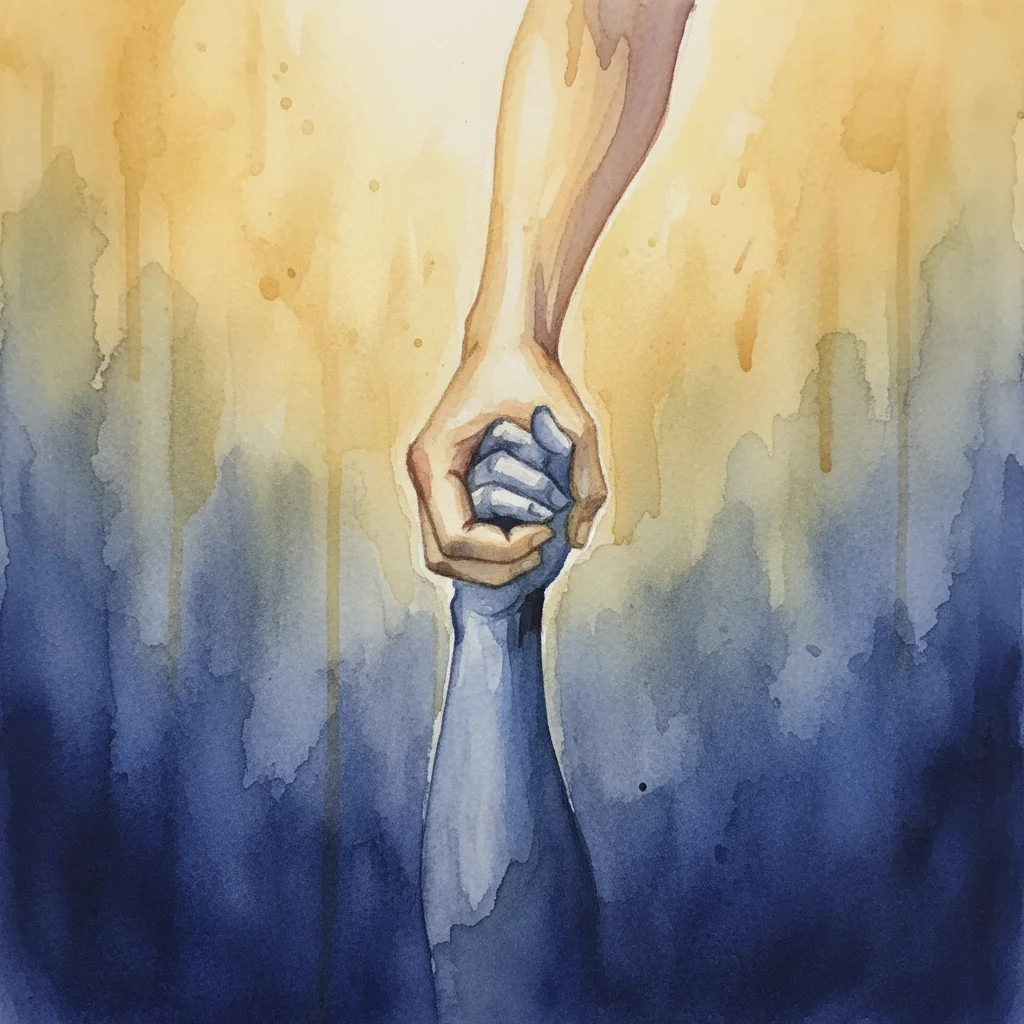
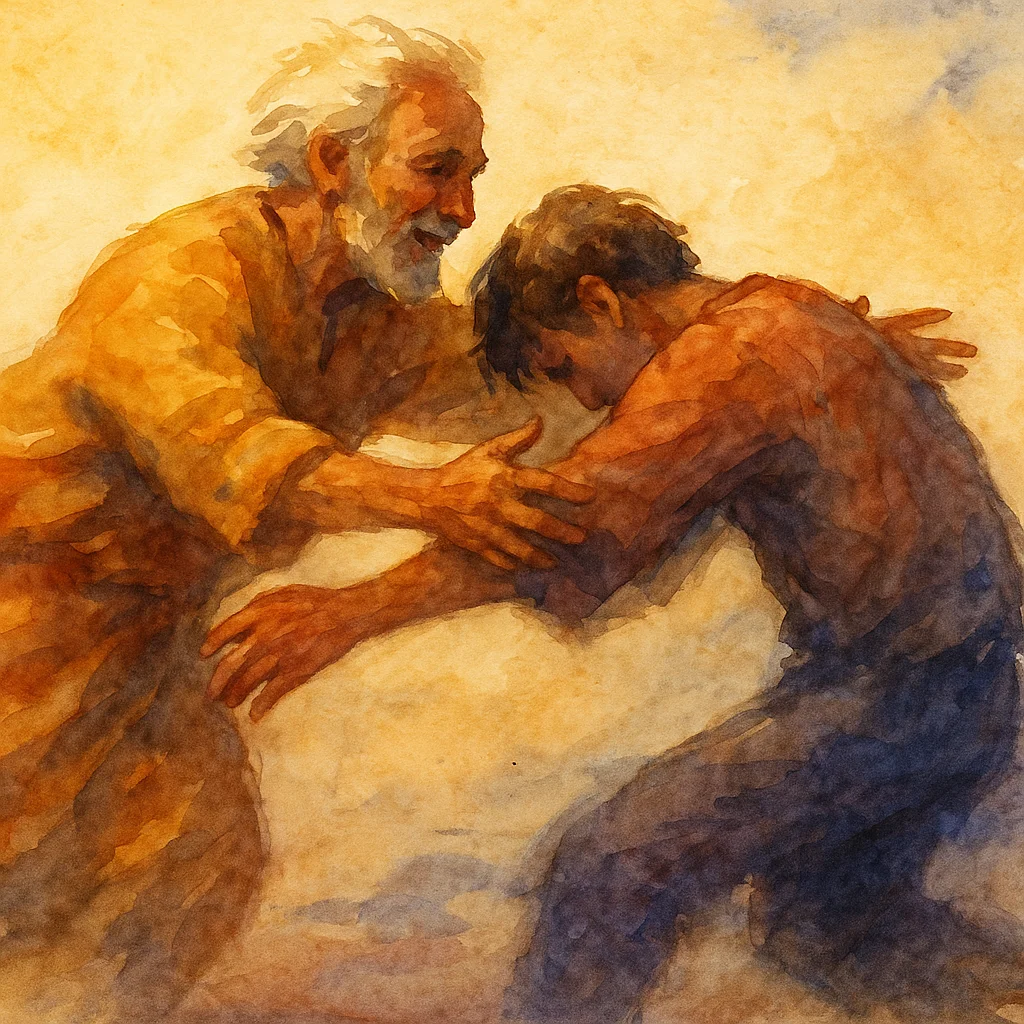
This is not pious flourish. It is in the Creed. It is in the Catechism. And it is in the icon every Eastern Christian sees on Easter morning - the Anastasis, the "Resurrection" icon - which shows Christ standing on the broken doors of Hades, reaching down, and pulling Adam and Eve up by the wrist. The gesture in the icon is forceful, not invitational. He does not ask. He pulls. Behind Adam and Eve: the prophets. David. Solomon. John the Baptist. The whole company of the righteous dead. He goes down for them.
The ancient Holy Saturday homily that the Church reads in the Office of Readings each year, on the Saturday between Good Friday and Easter, puts it in Christ's own voice:
"Something strange is happening - there is a great silence on earth today, a great silence and stillness. The whole earth keeps silence because the King is asleep... He has gone to search for our first parent, as for a lost sheep." (CCC 635)
He goes for the first parent. For Adam. For everyone before him.
The Letter to the Hebrews stands behind this. Hebrews 11 is the long roll call of the faithful: Abel, Enoch, Noah, Abraham, Sarah, Moses, the prophets - all of whom "died in faith, not having received the things promised, but having seen them and greeted them from afar" (Heb 11:13). And then verses 39-40: "all these, though well attested by their faith, did not receive what was promised, since God had foreseen something better for us, that apart from us they should not be made perfect." Their salvation, in the Catholic reading, is not separate from Christ's. It is bound up with his. He goes back for them.
So when you ask whether your ancestors who lived before Christ - in China, in Taiwan, anywhere - were condemned for being born too early, the Church's answer, in its oldest formula, is no. The Redeemer who came in time goes back through it.
A note on the level of certainty. The fact of the descent is in the Creed and the Catechism. The mechanics - what was preached, how the dead heard, in what manner the righteous of every nation were gathered - the Church does not define. Catholics in good faith hold this with confidence as to the substance and humility as to the choreography. That is not evasion. It is the appropriate posture for a doctrine that hands you a real claim and refuses to dramatize past it.
The harrowing of hell answers the question for those who lived before Christ. The asker's question reaches further: what about people who lived after Christ, in places, families, or generations where his name never came?
The Second Vatican Council addressed this directly in Lumen Gentium 16 (promulgated 21 November 1964), picked up at CCC 847:
"Those who, through no fault of their own, do not know the Gospel of Christ or his Church, but who nevertheless seek God with a sincere heart, and, moved by grace, try in their actions to do his will as they know it through the dictates of their conscience - those too may achieve eternal salvation."
CCC 1260 generalizes:
"Every man who is ignorant of the Gospel of Christ and of his Church, but seeks the truth and does the will of God in accordance with his understanding of it, can be saved. It may be supposed that such persons would have desired Baptism explicitly if they had known its necessity."
Paul makes essentially this point himself in Romans 2: Gentiles "who do not have the law" but "do by nature what the law requires" - their conscience does real work outside explicit revelation.
Two things have to be held together here, and they are hard to hold at the same time.
The door is open. The Church teaches the genuine possibility of salvation for those who, through no fault of their own, never encountered Christ. This is doctrine, not pastoral softening.
The verdict is not ours. The Church does not pronounce on the damnation of any specific soul, and it pronounces on the salvation of specific souls only through the deliberate process of canonization (CCC 828). For everyone else - including those outside the visible Church and including most of our own loved ones - the verdict belongs to God.
Holding both is uncomfortable, especially when the souls in question are people you loved. The tradition does not pretend it isn't. The practice that holds the two together is older than the difficulty: prayer for the dead. Catholics have prayed for our dead since the catacombs. The fact that the verdict is not ours does not mean intercession is useless. It means it is exactly the right thing.
A second caveat is worth naming, calmly. The Catholic teaching that the door is open is not a teaching that hell is empty or merely metaphorical. CCC 1033-1037 is unambiguous: hell is real, and the possibility of definitive self-exclusion from God exists. The Church does not say no one is in hell. It says the door Christ opened is wider than any one century, language, or geography, and that the verdict on individual souls belongs to God. Those are not the same claim, and the article would be dishonest if it conflated them.
If the picture you grew up with - or absorbed by accident - was a God who damns people for being born in the wrong place, the Catholic Church does not teach that picture and never has. What it teaches is harder and more honest: that conscience is real, that grace reaches further than we can see, that hell is also real, and that the verdict on individual souls belongs to God.
If the righteous before Christ were not lost, and if those who never heard him can still be saved, the question sharpens. Why the Incarnation? Why this particular costly intervention - the Word becoming flesh, walking around dusty Galilee, dying under a Roman governor on a particular Friday afternoon?
The phrase "to prove a point" is the phrase to dismantle, because it carries a wrong picture. Not because the picture is irreverent. Because it is too small.
The deepest answer the Catholic tradition gives - older than the Creed in its received Latin form, older than any of the medieval theologians - comes from St. Athanasius of Alexandria (c. 296-373), in On the Incarnation (De Incarnatione Verbi), written around 318 AD.
"He became what we are that he might make us what he is." (De Incarnatione 54, in the standard English paraphrase)
The Catechism cites the same passage in slightly different words:
"For the Son of God became man so that we might become God." (CCC 460)
That sentence is meant to startle. The Catholic claim - and this is the heart of the matter - is not that Jesus came to teach a moral lesson, or to settle a cosmic argument, or to make a point. He came to take human nature into the life of God, and to bring all of us with him. The Greek word for this endpoint is theosis - divinization, deification. We are made "partakers of the divine nature" (2 Pet 1:4, cited at CCC 460).
This is not a niche term, and not a poetic flourish. It is the destination Christianity actually proposes. Not "avoid hell." Partake in the divine life.
Athanasius's underlying argument, drawing on De Incarnatione §§6-10 and §§13-20, runs roughly like this. Human beings were made for incorruption - for life with God. Sin introduced not only moral failure but the unraveling of human nature itself toward death. To heal what is internal to human nature, the healer has to enter human nature. A decree from outside is not nothing - God is sovereign and could have done otherwise (more on that below) - but a decree from outside does not transfigure us from within. The Word came inside the condition that needed healing. He took the whole of it: birth, body, hunger, betrayal, death. Not because God needed to perform something for us to see, but because nothing less actually transfigures.
This is the Athanasian answer to "why not just forgive us with a thought." The honest reply is: God could have. But what we needed was not just a verdict of forgiveness. We needed to be drawn into his life. The Word became flesh because that is the form drawing-in takes when the beloved is finite, embodied, mortal, and far away.
Seven centuries after Athanasius, St. Anselm of Canterbury wrote Cur Deus Homo - "Why God Became Man" (1098). His angle is different: not how does the Word heal human nature from within, but how does perfect justice and the love of God meet in one event without either compromising the other.
A common reading of Anselm goes like this: humanity sinned, God required payment, Jesus paid it, the books are now balanced. That reduction does Anselm a disservice. His own framework is more careful. Humanity owes a debt to God's honor that humanity must pay (because justice is real and the harm done by sin is real) but cannot pay (because the debtor is finite and the One offended is infinite). Only one who is both fully God and fully man can offer satisfaction with the weight of God himself, on behalf of the humanity that owes it. The Catholic tradition, drawing this together with Athanasius, reads Anselm's logic as a form of love that does not bypass justice. The cross is what mercy weighs.
There is an honest seam to acknowledge here. Eastern Orthodox theology has substantive reservations about Cur Deus Homo, not just about its caricatures. Anselm's framing of sin as a debt against divine honor uses a feudal conceptual vocabulary the Greek Fathers did not use, and which arguably travels poorly when extracted from its setting. The Catholic tradition holds Anselm and Athanasius together; the Eastern tradition leans more strongly Athanasian. The seam between them is real. This article does not try to dissolve it - it commends both, and notes that the Catholic Catechism cites both because the mystery is large enough for both.
The substitutionary thread Anselm articulates is also a biblical thread, not a Western invention. Isaiah 53:5: "But he was wounded for our transgressions; he was bruised for our iniquities; upon him was the chastisement that made us whole." Romans 3:25: God put Christ forward "as a propitiation by his blood, to be received by faith." Galatians 3:13: "Christ redeemed us from the curse of the law by becoming a curse for us." The Catholic tradition does not erase this strand. It holds it inside theosis rather than against it: Christ takes on what we owe in order to draw us into the life that is his.
Both Athanasius and Anselm assume that God could have done otherwise. Aquinas asks the question explicitly. Summa Theologiae III, Q. 1, a. 2: "Was it necessary for the restoration of the human race that the Word of God should become incarnate?" His answer is no - not in the sense that God was forced into it. God in his omnipotence could have saved humanity another way. The Incarnation was fitting - the most fitting - given who God is and who we are.
The word for this in Aquinas is convenientia, and it is doing more work than the English "fitting" suggests. It does not mean "one tasteful option among several." It means the supremely appropriate expression of the divine nature. Aquinas in ST III, Q. 1, a. 2 lists ten convenientiae, in two groups of five. For our progress in the good: it furthers our faith, raises our hope, kindles our charity, gives us an example of right action, and makes us "partakers of the divine nature." For our withdrawal from evil: it teaches us not to prefer the devil to ourselves, instructs us in the dignity of human nature, restrains presumption, removes despair (because we see God taking on our condition), and looses us from the servitude of sin.
The pattern matters for the asker. God was not boxed in. He chose this. The choice is free. And the choice tells you what kind of God he is.
The Catechism, drawing on both the Eastern and Western traditions, gives a compact summary across CCC 457-460. It is worth reading directly, because it is the official answer to the asker's question:
"The Word became flesh for us in order to save us by reconciling us with God." (CCC 457)
"The Word became flesh so that thus we might know God's love." (CCC 458)
"The Word became flesh to be our model of holiness." (CCC 459)
"The Word became flesh to make us 'partakers of the divine nature.'" (CCC 460)
Four answers, all in the Catechism, all in one place. None of them is "to prove a point." All of them are forms of one verb. He came to love us, all the way through.
If you can hold one image instead of an argument, hold this one.
It is Holy Saturday. The world has gone silent. Christ, between his death on Friday and his rising on Sunday, goes down. He goes into Sheol. He finds Adam there, the first parent, and Eve. He finds Abraham who waited. He finds the prophets who promised something they could not yet see. He takes Adam by the wrist - in the icon, he does not gently invite, he pulls - and he brings them up.
That is what the Catholic Church teaches happened in the silence of Holy Saturday. That is the answer to "did all those born before Jesus' time go to hell." The answer is in the Creed you can recite. He went down for them. He brought them up.
The question of whether your own ancestors are among the company being lifted is not yours to answer, and the Church does not pretend to. But the door the Church teaches is the one Christ broke open. It opens backwards in time as well as forwards. It opens for the people who waited without knowing what they were waiting for. The Catholic claim is that the love that comes to find you in your own life is the same love that went down looking for the lost sheep on Holy Saturday, and did not come back without them.
Five tiers, in the order CatholicIndex uses them across Q&A articles - dogma, doctrine, discipline, theological opinion, and pastoral practice.
Dogma and doctrine (settled):
Discipline (changeable; currently in force):
Theological opinion (legitimately open):
Pastoral practice (varies):
These are not failures of clarity. They are working judgments inside a doctrine that does not move on the part the asker most needs.
If this question has been keeping you up - especially the part about people you love who lived and died outside the faith - here is what the tradition would suggest, in order:
Pray for them by name. This is not in tension with the doctrine; it is the doctrine in action. Catholics have prayed for the dead since the catacombs. The fact that the verdict is not ours does not mean intercession is useless. It is exactly the right thing.
Read CCC 456-460 and CCC 631-635 in one sitting. Two short passages. They are the spine of this article and reading them in the Catechism is a different experience from reading them quoted.
Read the Holy Saturday homily. It is one page, in the Office of Readings for Holy Saturday. The Church reads it once a year. You can read it any night.
Sit with the Anastasis icon. Image search "Anastasis icon" or "Harrowing of Hell." Notice where Christ's hand is. Notice that he is reaching down. Notice who is being pulled up. The doctrine is in the picture in a way it isn't in the words.
Talk to a parish priest. If the fairness question is still keeping you up, this is exactly the conversation a priest is trained for. Ask at the parish desk for a priest who works with RCIA or adult catechumens; you will not be the first person to bring this to him.
Do not solve the verdict. The Church refuses to pronounce on the damnation of any specific soul, and pronounces on the salvation of specific souls only through canonization (CCC 828). Following the Church on this means letting the verdict go and trusting the Judge. This is not abdication. It is the same humility the Church practices about itself.
To find a parish near you, see / and /churches. To find confession times, see /confession.
No. The Apostles' Creed itself teaches that Christ "descended into hell," and the Catechism (CCC 631-635) reads that clause as Christ going down to the realm of the dead - Sheol in Hebrew, Hades in Greek - to deliver the righteous who had been waiting for the Redeemer. Catholic tradition calls that company the limbus patrum, the "limbo of the fathers." It was a waiting, not a punishment. CCC 633: "It is precisely these holy souls, who awaited their Savior in Abraham's bosom, whom Christ the Lord delivered when he descended into hell." This is what is depicted in the Anastasis icon every Eastern Christian sees at Easter: Christ pulling Adam and Eve up by the wrist, with the prophets behind them. The righteous before Christ were not lost. He went down for them.
The Church teaches the genuine possibility of their salvation, while refusing to pronounce on any individual soul. Lumen Gentium 16 from the Second Vatican Council, picked up at CCC 847, states that "those who, through no fault of their own, do not know the Gospel of Christ or his Church, but who nevertheless seek God with a sincere heart, and, moved by grace, try in their actions to do his will as they know it through the dictates of their conscience - those too may achieve eternal salvation." CCC 1260 generalizes this. The door is open. The verdict on individual souls is not ours - it belongs to God. The right Catholic practice for loved ones who died outside the faith is prayer for them by name, which Catholics have done since the catacombs.
He did not "need" to in the strict sense - Aquinas in Summa Theologiae III, Q. 1, a. 2 is direct that God could have saved humanity another way. The Incarnation was not absolutely necessary; it was the supremely fitting expression of who God is. Why fitting and not arbitrary? Two reasons the tradition gives. First (Athanasius, On the Incarnation): only the Word who created human nature could heal it from within; an external decree of forgiveness does not transfigure what is internal to a creature. Second (Anselm, Cur Deus Homo): the form love takes when it does not bypass justice, in the case of finite creatures who have wronged an infinite Goodness, looks like the God-Man offering satisfaction on humanity's behalf. The Catholic Church holds both answers. The Catechism summarizes the result at CCC 457-460: he came to reconcile us with God, to show us his love, to be our model, and to make us "partakers of the divine nature." None of these is "to prove a point."
Not what most people assume on first read. CCC 633 is explicit: "Scripture calls the abode of the dead, to which the dead Christ went down, 'hell' - Sheol in Hebrew or Hades in Greek - because those who are there are deprived of the vision of God." The "hell" of the Creed is the realm of the dead in the older Jewish picture, where the righteous and the unrighteous waited - not the hell of the damned. Christ went down on Holy Saturday, between his death and resurrection, to gather the holy souls who had been awaiting him - Abraham, Moses, the prophets, every just person who had lived in faithful waiting. The fact of the descent is settled doctrine; the mechanics (what was preached, how the dead heard) are not defined and are an area of legitimate theological discussion.
"Limbo" actually refers to two distinct historical questions, and they should not be confused. The limbus patrum - the "limbo of the fathers" - is in the Creed: it is the place where the righteous of the Old Testament waited for the Redeemer, and it is what Christ harrowed at his descent (CCC 633). That is the topic of this article and is settled doctrine. The other "limbo" - the historical theological discussion of unbaptized infants - is a separate question, never defined as doctrine. The most recent magisterial-adjacent treatment is the International Theological Commission's 2007 document The Hope of Salvation for Infants Who Die Without Being Baptised, which expresses serious theological hope for their salvation while leaving the verdict to God. The two limbos answer different questions and should not be collided.
Yes. The Catechism is unambiguous at CCC 1033-1037: hell is real, and the possibility of definitive self-exclusion from God exists. The teaching that the door Christ opened is wider than any one century or geography is not the same as a teaching that hell is empty or merely metaphorical. The Catholic position is more careful than either extreme: hell is real; the verdict on any specific individual soul is not ours; the Church has never named anyone as damned, and pronounces on individual salvation only through the deliberate process of canonization (CCC 828). Hold both halves. Either alone produces a caricature.
Catechism of the Catholic Church
Magisterial Documents
Theological Works
Scripture (cited in this article)
Iconography
Pastoral Resources